Rise Health & Wellness Peptides

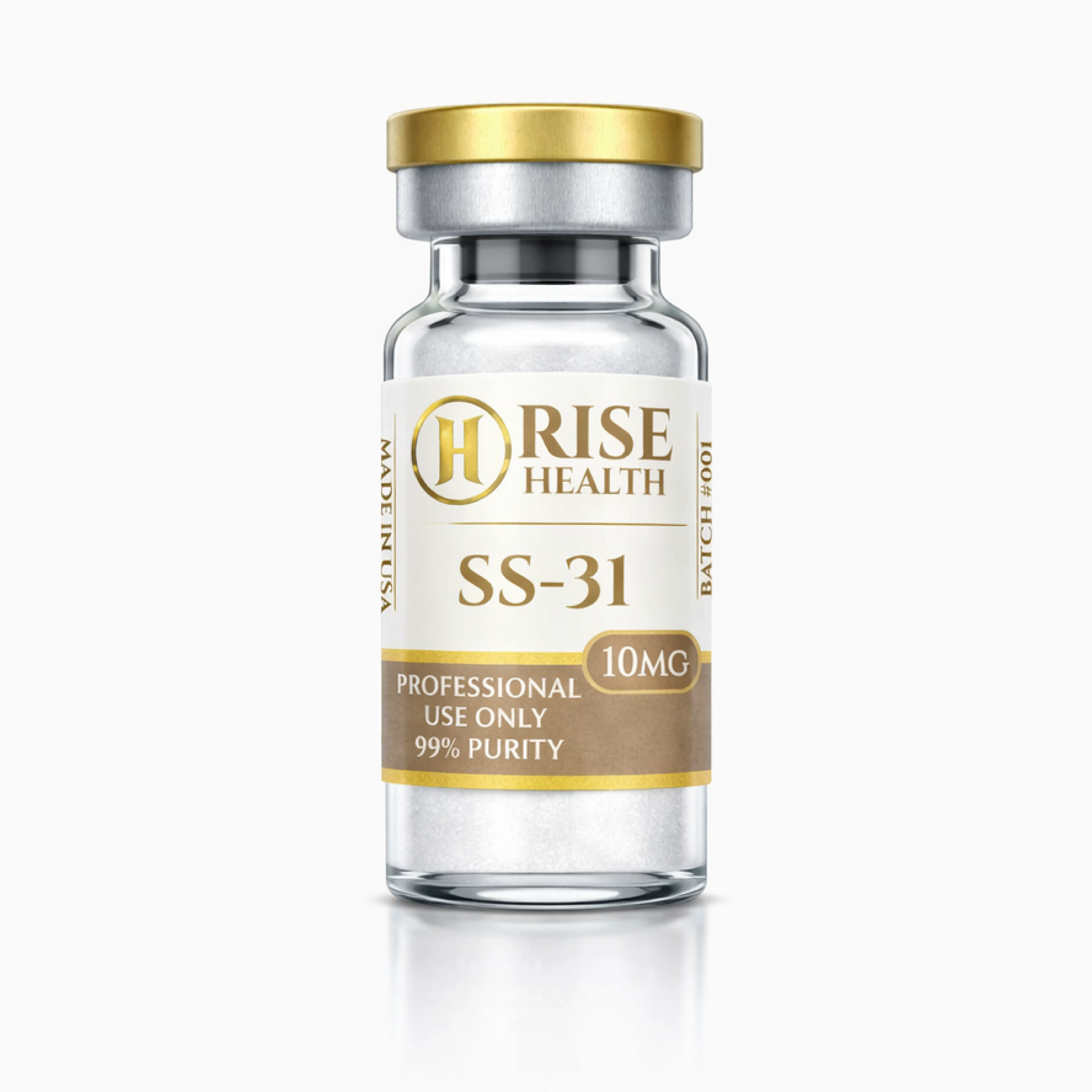
SS-31 (10mg)
$75.00 USD
Buy Now
Rise Health

SS-31 is a mitochondria-targeted synthetic peptide from the Szeto-Schiller (SS) family, designed to protect and restore mitochondrial function. It selectively accumulates in the inner mitochondrial membrane (IMM), stabilizes cardiolipin, reduces oxidative stress, and enhances ATP production. SS-31 has been widely studied for its therapeutic potential in neurodegenerative, cardiovascular, metabolic, and renal conditions where mitochondrial dysfunction is a core issue.

Current Research Focus

Primary Research Areas:

  • Neurodegenerative diseases (Alzheimer’s, Parkinson’s, ALS)
  • Heart failure and cardiac ischemia
  • Mitochondrial myopathy and aging-related muscle decline
  • Chronic kidney disease and acute kidney injury
  • Inflammation and oxidative stress-related disorders
  • Metabolic health and insulin sensitivity
Mechanism of Action

1. Mitochondrial Targeting via Cardiolipin Binding: Rapid cellular uptake and localization to the inner mitochondrial membrane through selective binding to cardiolipin.

2. Cristae and Inner Mitochondrial Membrane Stabilization: Preserves mitochondrial structure, preventing apoptosis and membrane degradation.

3. Reactive Oxygen Species (ROS) Reduction: Limits electron leakage from the electron transport chain, reducing mitochondrial-generated oxidative stress.

4. ATP Production Optimization: Enhances electron transport chain efficiency, improving mitochondrial respiration and energy output.

Key Research Studies

1. Mitochondrial Protection & ATP Restoration

  • Study focus: Cardiolipin binding and ATP production
  • Key findings: Stabilized inner mitochondrial membrane (IMM), improved electron transport chain (ETC) function, enhanced ATP generation
  • Reference: Szeto HH et al., 2011

2. Reduction of Oxidative Stress & Inflammation

  • Study focus: ROS and cytokine levels in cardiac injury
  • Key findings: Decreased oxidative stress markers and inflammatory cytokines
  • Reference: Birk AV et al., 2013

3. Neurodegenerative Disease Models

  • Study focus: Cognitive performance in Alzheimer’s disease models
  • Key findings: Reduced neuroinflammation, improved mitochondrial function, enhanced memory outcomes
  • Reference: Yang L et al., 2020

4. Cardioprotection in Heart Failure

  • Study focus: Heart failure with reduced ejection fraction (HFrEF)
  • Key findings: Preserved cardiac output and improved mitochondrial respiration
  • Reference: MMPOWER-3 Phase 2 Clinical Trial

5. Muscle Function & Metabolism

  • Study focus: Muscle fatigue and mitochondrial performance
  • Key findings: Improved endurance, enhanced mitochondrial output, and improved insulin sensitivity
  • Reference: Campbell MD et al., 2019

6. Kidney Protection

  • Study focus: Ischemia and oxidative injury in renal tissue
  • Key findings: Reduced kidney damage and preserved mitochondrial integrity
  • Reference: Szeto HH et al., 2017
Biological Effects and Benefits
Mitochondrial Targeting via Cardiolipin Binding:
Enables rapid cellular uptake and localization to the inner mitochondrial membrane through cardiolipin binding.
Cristae and Inner Membrane Stabilization:
Preserves mitochondrial structure, helping prevent apoptosis and membrane degradation.
Biological Effects
ROS Reduction:
Limits electron leakage within mitochondria, reducing oxidative stress generated during energy production.
ATP Production Optimization:
Enhances electron transport chain efficiency, improving overall cellular energy output.

Biological Effects and Benefits

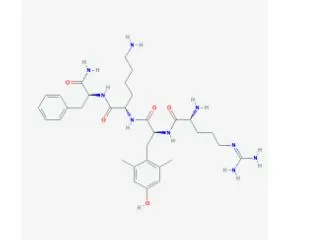
Sequence: D-Arg-2′,6′-dimethyltyrosine-Lys-Phe-NH₂

Molecular Formula: C₃₀H₅₀N₈O₇

Molecular Weight: 639.77 g/mol

Related Products